

A living annuity is one of the most popular retirement income products in South Africa, and for good reason. It offers flexibility, control over your capital, and the potential to leave something for your family. But that flexibility comes with a responsibility that many retirees underestimate: the drawdown decision.
How much you withdraw each year is one of the single most powerful drivers of whether your living annuity lasts a lifetime, or runs dry too soon. This guide explains what drawdown means, why it matters so much, and how to approach it intelligently.
What Is a Living Annuity Drawdown?
In South Africa, a living annuity allows you to withdraw an annual income within a regulated range. Your drawdown rate is reviewed once a year on your policy anniversary, at which point you can adjust it within the permitted band.
Think of your living annuity portfolio as a bucket. Investment returns pour in from the top; your income drawdown flows out from the tap at the bottom. As long as the inflow at least matches the outflow, your bucket stays full. When withdrawals consistently exceed returns, especially in the early years of retirement, the bucket gradually empties.
💡 The drawdown is not free money. It is a planned withdrawal from a portfolio that must still fund many years of future income. Every rand taken out today is a rand that can no longer grow.
Why the Drawdown Decision Matters More Than Most People Expect

Most retirees focus on investment returns first. That matters, but the real equation is: drawdown + return + time. Two retirees can earn exactly the same average investment return over 20 years and end up in very different financial positions, purely because one withdrew too much too soon.
Once capital is reduced, it has to work harder to recover, while withdrawals continue during that recovery. This is why managing withdrawal behaviour through good and bad markets is often more important than chasing higher returns.
The Big Hidden Risk: Sequence of Returns
Sequence of returns risk is a simple concept with a significant impact: poor investment returns early in retirement cause far more damage than the same poor returns later in retirement, because withdrawals are happening while the portfolio is already down.
Here is a practical illustration:
- A retiree begins retirement with R3,000,000 in a living annuity.
- They draw 6% per year (R180,000 before tax).
- In year two, markets fall sharply. The retiree still needs income and continues withdrawing at lower portfolio prices.
- The portfolio now has significantly less capital available to participate in the eventual market recovery.
This does not mean retirees should avoid growth assets or panic during a downturn. It means the income plan needs pre-agreed rules for what happens after a weak market year, before emotions take over.
A Practical Three-Layer Spending Framework
A proven approach to managing drawdown is to categorise your spending into three layers. This helps you protect what matters most while building flexibility into what can wait.
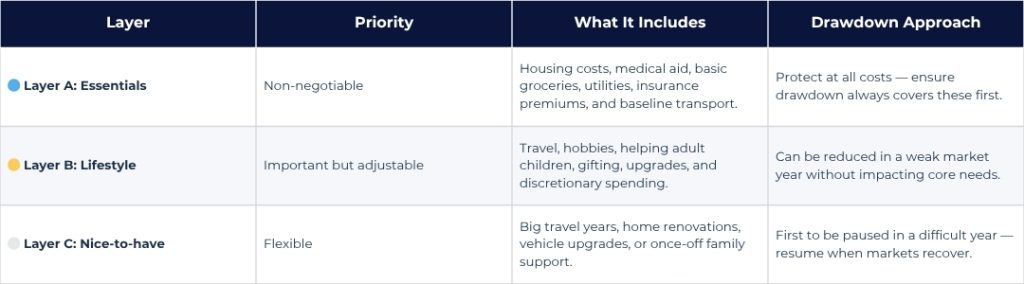
The drawdown target should ensure that Layer A is always covered, even in a tough market year. Layers B and C provide the flexibility buffer. This tiered approach helps retirees feel they are protecting the essentials and managing the rest intelligently, rather than simply cutting everything.
What Is a Sustainable Drawdown Rate?
There is no universal number because your sustainable drawdown depends on several factors working together:
- Your time horizon: How long your retirement is likely to last.
- Expected inflation: How fast costs will rise over time.
- Your portfolio mix: The balance between growth and income assets.
- Total fees: What you pay in platform, advice, and fund costs annually.
- Spending flexibility: How much you can reduce withdrawals in a difficult year.
A sensible starting approach looks like this:
- Start with essential expenses and establish the minimum monthly income required.
- Set an initial drawdown that covers essentials plus a reasonable lifestyle margin.
- Define in advance what will happen in a poor return year, a smaller increase, or a temporary hold.
- Review annually with your adviser using a consistent, disciplined method rather than reacting emotionally.
Inflation Increases: A Decision, Not a Default
Many retirees treat an annual income increase as automatic. But inflation-linked drawdown increases are only sustainable when the portfolio can genuinely support them.
In a strong market year: a full inflation-linked increase is likely reasonable.
In a weak market year: a smaller increase, or no increase at all, can protect many future years of income.
💡 One year of restraint on income increases can protect multiple years of future income sustainability. This is where a good financial adviser adds real, measurable value.
Fees: Small Leaks That Become Big Problems

Fees matter most when combined with a high drawdown rate and inconsistent decision-making. The right question is not whether fees are high or low, it is whether your drawdown plan is realistic after fees, not before them.
A disciplined drawdown strategy can be quietly undermined when total costs (platform fees, advice fees, and fund costs) are higher than anticipated, and the retiree still tries to maintain the same income level. Always calculate your net income position after all costs are accounted for.
The Bottom Line: A Framework, Not a Formula
The living annuity drawdown decision is not a once-off calculation, it is an ongoing discipline. Markets change, inflation changes, health and lifestyle change. What matters is having a structured, pre-agreed plan that removes emotion from the equation.
Start with your essentials. Build in flexibility. Define your rules for good and bad years. Review consistently. And work with an adviser who helps you see the long game, not just the next income payment.
Read about the difference between Living Annuity vs Life Annuity in SA and be sure to join the RetireSmart SA WhatsApp Channel for more tips, information and help to ensure your retirement is planned correctly.
Disclaimer:
This article is for educational and informational purposes only and does not constitute financial advice. RetireSmart SA (Pty) Ltd is an Authorised Financial Services Provider (FSP No. 42532). Please consult a qualified financial adviser before making any retirement income decisions.