
When South Africans retire, one of the most important financial decisions they face is how to convert their retirement savings into a reliable income.
Most retirees must choose between two primary retirement income products:
- Living annuities
- Life (guaranteed) annuities
Both options serve the same purpose, providing income in retirement… but they differ significantly in terms of flexibility, income certainty, investment risk and estate planning.
Understanding how these products work, and the trade-offs between them, is essential when designing a retirement income strategy that balances security, sustainability and financial flexibility.
What Is a Living Annuity?
A living annuity is a retirement income product that allows retirees to withdraw a flexible income from their retirement savings while keeping the remaining capital invested.
Instead of receiving a fixed pension, the retiree chooses an annual withdrawal rate from their invested capital.
You may withdraw between 2.5% and 17.5% of their capital each year, with the withdrawal rate reviewed annually.
Key characteristics of a living annuity
- Flexible income withdrawals
- Investment portfolios remain market-linked
- Retirees can change underlying investments
- Remaining capital can pass to beneficiaries
This flexibility provides retirees with control over their retirement assets, but it also means they remain exposed to investment risk, inflation risk and longevity risk.
What Is a Life Annuity?
A life annuity, is also often called a guaranteed annuity, converts retirement savings into a guaranteed income that is paid for the rest of the retiree’s life.
Once the capital is transferred to an insurer, the insurer assumes responsibility for generating the income payments.
This structure removes the uncertainty associated with market performance and longevity.
Key characteristics of a life annuity
- Guaranteed income for life
- No investment decisions required from you
- Longevity risk transferred to the insurer
- Optional inflation-linked income increases
The trade-off is that retirees typically give up access to the capital used to purchase the annuity.
Living Annuity vs Life Annuity: Key Differences
The fundamental difference between the two products is the trade-off between flexibility and certainty.
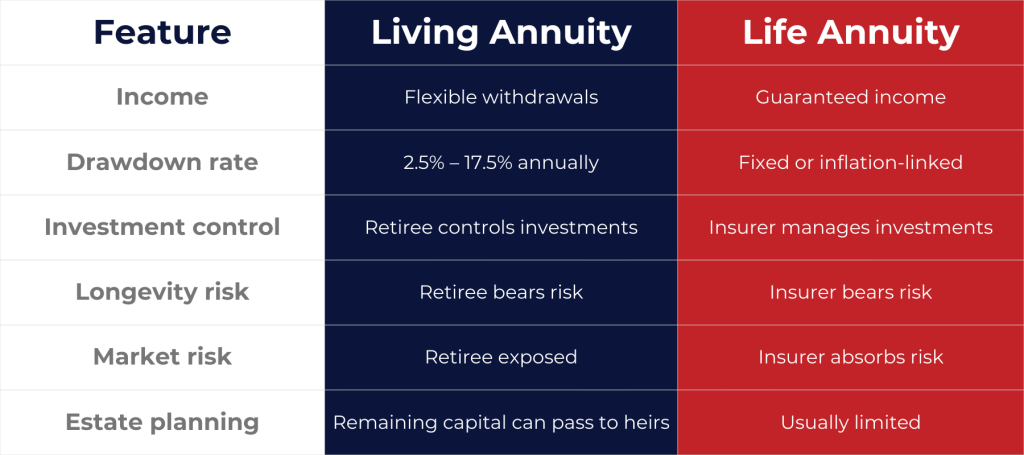
**Both products address retirement income needs, but they do so in fundamentally different ways.

Income Flexibility vs Guaranteed Income
Living annuities provide retirees with significant flexibility.
Income levels can be adjusted annually to reflect changing financial needs, and the investment portfolio can be modified over time to respond to market conditions or evolving risk tolerance.
However, this flexibility comes with responsibility.
If withdrawals are too high or investment returns are poor, the capital supporting the annuity may decline faster than expected. Over time, this can lead to a reduction in sustainable retirement income.
Life annuities provide the opposite approach.
Because income payments are guaranteed for life, retirees benefit from predictable income that continues regardless of market performance or lifespan.
For many retirees, this certainty can provide valuable financial stability.
Longevity Risk in Retirement
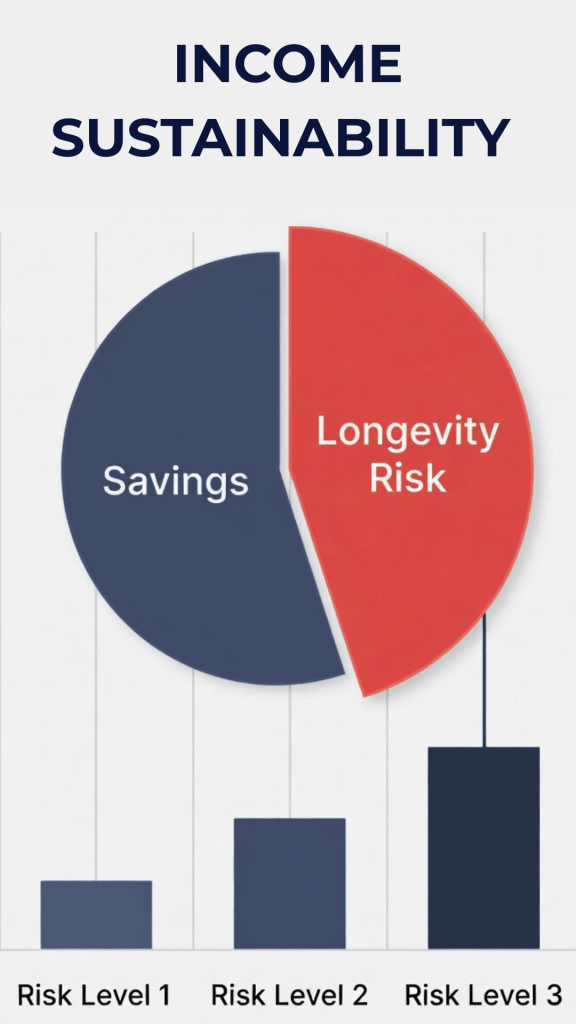
One of the biggest financial risks retirees face is longevity risk, the possibility of living longer than their retirement savings last.
This risk has become increasingly important as life expectancy continues to rise.
Living annuities place the responsibility for managing longevity risk on the retiree.
Income sustainability depends on:
- investment performance
- withdrawal rates
- how long the retiree lives
Life annuities remove this uncertainty by transferring longevity risk to the insurer.
Regardless of how long the retiree lives, the income continues for life.
Inflation Risk and Purchasing Power
Inflation is another major challenge for retirement income planning.
Over time, rising prices reduce the purchasing power of fixed income streams.
Living annuities can help address inflation risk because the capital remains invested in growth assets such as equities. If investments perform well, retirees may be able to increase their income over time.
Life annuities may also offer inflation-linked income options, although these typically start with a lower initial payment compared with fixed annuities.
Balancing income stability with long-term purchasing power is therefore a key consideration when choosing between the two structures.
Retirees should therefore consider how their income strategy will perform not only in the early years of retirement, but also over a potentially long retirement horizon where inflation can significantly erode the real value of income.
Fees and Cost Considerations

Costs matter enormously over long retirement periods. A difference of even 1% in annual fees can compound into a significant reduction in lifetime income over 20 to 30 years.
Living annuity fees are transparent and typically include annual platform/advice fees (1%–2%), underlying fund fees (0.5%–1.5%), and sometimes performance fees. You can compare, negotiate, and switch providers.
Life annuity costs are embedded in the income rate offered by the insurer, profit margins, administration, and mortality assumptions are all priced in but not itemised. Always compare the total income offered across multiple insurers, not just the headline number.
💡 Focus on total economic impact, not just visible fees. A living annuity with 1.5% annual fees may deliver better lifetime value than a life annuity — or it may not. The maths depends on your health, investment returns, and drawdown rate.
Can You Blend Both Approaches?
Many retirement planning specialists recommend a hybrid strategy that combines the strengths of both products. Some practical approaches include:
- Core-Satellite: Use a life annuity to cover essential expenses (rent/bond, food, healthcare) and a living annuity for discretionary spending and legacy planning.
- Phased Annuitisation: Start retirement with a living annuity for flexibility, then gradually convert portions into a life annuity as you age.
- Laddered Purchases: Instead of one large annuity purchase, buy smaller life annuities over several years to average out interest rate movements.
As a practical guide: if 70% of your expenses are non-negotiable, consider targeting at least 70% of your income from guaranteed or predictable sources.
How to Make Your Decision
Your annuity choice should be driven by your personal circumstances, not by generic financial theory. Ask yourself:
- Can I comfortably manage income fluctuations, or do I need certainty to sleep at night?
- What is my health status and family history of longevity?
- Is leaving an inheritance to my family important to me?
- How flexible are my monthly expenses, can I cut back if needed?
- Does my spouse depend on this income, and what happens to them if I pass away first?
A helpful starting point: calculate what your essential monthly expenses are, and ensure that at least that amount is covered by guaranteed or predictable income. The remainder can be positioned for growth and flexibility.
Remember: a living annuity can be converted to a life annuity later, but the reverse is not possible. There is no perfect answer, only the one that best fits your life.
Disclaimer:
This article is for educational and informational purposes only and does not constitute financial advice. RetireSmart SA (Pty) Ltd is an Authorised Financial Services Provider (FSP No. 42532). Please consult a qualified financial adviser before making any retirement income decisions.